

Quick answer
The Church of Our Lady of the Rocks is open daily from 09:00 to 18:00, with a 5 EUR conservation fee per person payable in cash on arrival. The best arrival window is 09:00–11:00, when you avoid the midday cruise-ship groups and high summer temperatures. The island museum contains votive silver plaques and embroidered altar cloths made by local seafarers' wives over three centuries.
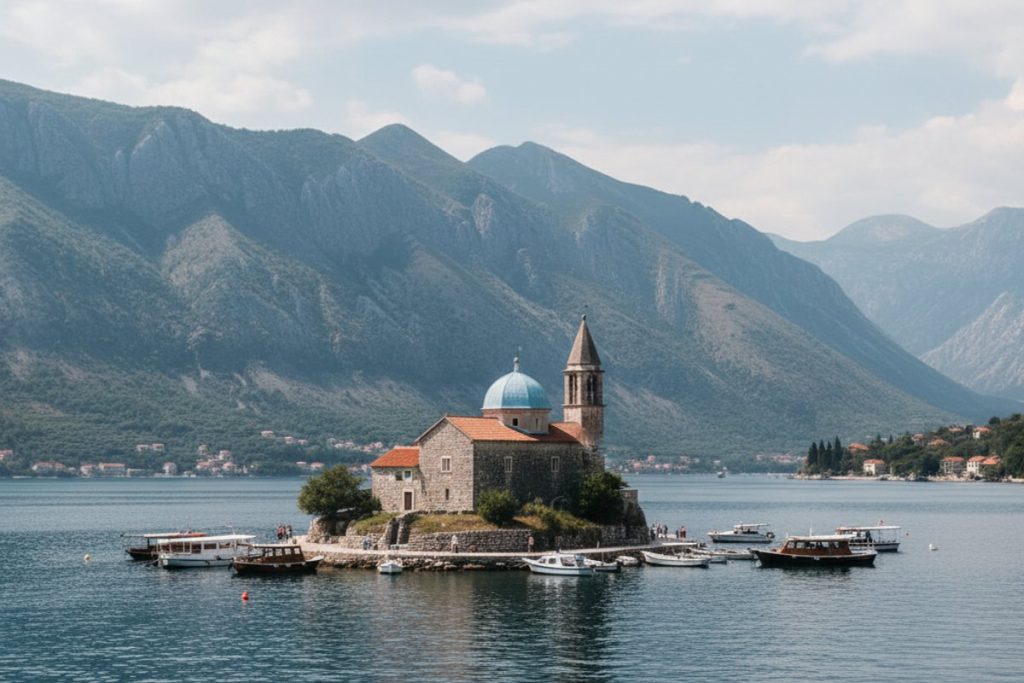
The island itself was built stone by stone starting in 1452, when local sailors began sinking captured pirate ships and adding boulders after each successful voyage. By the early 17th century, the reef had grown large enough to support a church, completed in 1630 and expanded with a bell tower in 1725. The baroque interior holds 68 frescoes by Tripo Kokolja, a local artist whose ceiling panels depict maritime miracles and patron saints of sailors. Most visitors arrive on organized bay tours departing from Kotor's old town waterfront, which include the island as part of a larger Boka Bay itinerary alongside Perast village and sometimes the submarine tunnels near Morinj. Independent travelers can also hire taxi boats from Perast harbor, a five-minute crossing that runs continuously during daylight hours. The church museum occupies the sacristy and two side chapels, displaying silver ex-votos donated by sailors who survived storms, an embroidered Madonna tapestry that took 25 years to complete, and ship models suspended from the ceiling beams. The island receives its heaviest foot traffic between noon and 16:00, when large cruise ships anchored in the outer bay send shore-excursion tenders. Morning visits allow quieter photography and better light on the church facade, which faces southeast. The conservation fee covers ongoing restoration of the frescoes and baroque altarpieces, which are vulnerable to salt air and humidity. There is no cafe or shop on the island; bring water if you plan to wait for a return boat during peak hours when taxi queues can stretch to 20 minutes.
“The reef was built stone by stone over five centuries, each boulder added by sailors returning safely to port.”
Optimal Timing for a Kotor Boat Tour Lady of the Rocks Visit
The best arrival window for visiting Lady of the Rocks is 09:00–11:00. Arriving during this period allows visitors to avoid peak cruise-ship crowds and the high temperatures often experienced midday.
May and September
ModerateMild, 20–25°C
These shoulder months offer favorable conditions for boat travel. The water is calm and the heat remains manageable during morning excursions.
July and August
HighHot, 30°C+
Early morning departures are necessary to escape peak crowds and intense afternoon sun. High humidity is common during these peak summer months.
Weekday mornings
Low to moderate—
Visiting mid-week helps circumvent the influx of weekend day-trippers from neighboring regions. Mornings remain the most comfortable time for maritime exploration.
Verdict: The most effective strategy is to target a weekday morning arrival between 09:00 and 11:00 during the months of May, June, or September.
Opening Hours for Kotor Boat Tour Lady of the Rocks
The Lady of the Rocks island and its museum are open daily to visitors. The operating schedule remains consistent throughout the week.
| Monday | 09:00–18:00 | |
|---|---|---|
| Tuesday | 09:00–18:00 | |
| Wednesday | 09:00–18:00 | |
| Thursday | 09:00–18:00 | |
| Friday | 09:00–18:00 | |
| Saturday | 09:00–18:00 | |
| Sunday | 09:00–18:00 |
How to Reach the Lady of the Rocks on Your Kotor Boat Tour
The Lady of the Rocks is located on an artificial islet in the Bay of Kotor, situated directly off the coast of Perast. Access is exclusively via boat from either Kotor or Perast.
Direct speed boat from Kotor Old Town port
Local taxi boat from Perast waterfront
Jadranska magistrala (E80) to Perast, then boat
The Historical Significance of the Lady of the Rocks Island
Our Lady of the Rocks stands as one of only two man-made islands in the Adriatic Sea. According to local legend, on 22 July 1452, two sailors from Perast discovered an icon of the Madonna and Child painted on a rock jutting from the bay. They interpreted the discovery as a divine sign. The seafaring community vowed to build a sacred site on the spot, and for the next two centuries, Perast's sailors deposited stones and scuttled captured pirate vessels to expand the reef. Every ship returning safely from a voyage added a boulder to the foundation. This practice, known as fašinada, continues each July when residents row out to lay fresh stones around the island perimeter. Construction of the baroque church began in 1630 and concluded in 1632 under the guidance of Venetian architects. The icon that sparked the island's creation remains enshrined within the church, surrounded by sixty-eight oil paintings by Tripo Kokolja, a 17th-century master from Perast. The most venerated artifact is an embroidered votive tapestry created over twenty-five years by Jacinta Kunić-Mijović, who wove her own hair into the silver and gold thread after her husband perished at sea. She completed the work in 1828, never having remarried. The church interior also houses a collection of 2,500 silver votive plaques left by sailors in gratitude for survival. A kotor boat tour lady of the rocks departs from Perast's waterfront throughout the day, reaching the island in five minutes. Visitors stepping ashore today encounter the same baroque silhouette that guided sailors home for four centuries. The church remains an active pilgrimage site, and the museum within displays maritime ex-votos, navigational instruments, and the Kunić tapestry beneath protective glass. The stone platform continues to grow each summer during the fašinada ceremony, perpetuating a ritual older than most European nation-states.
Two Perast sailors discover a Madonna icon on a rock in Boka Bay and vow to build a shrine
Sailors deposit stones and sunken ships to expand the artificial reef, creating an island foundation
Baroque church construction is completed under Venetian architectural supervision
Jacinta Kunić-Mijović embroiders a votive tapestry using her own hair, now the church's most famous artifact
The church accumulates over 2,500 silver votive plaques donated by sailors
The island is designated a protected cultural monument by Montenegrin authorities
Annual fašinada ceremony continues each July, with residents adding stones to the island perimeter
Check availability
Frequently asked questions about kotor boat tour lady of the rocks
Everything you need to know about kotor boat tour lady of the rocks